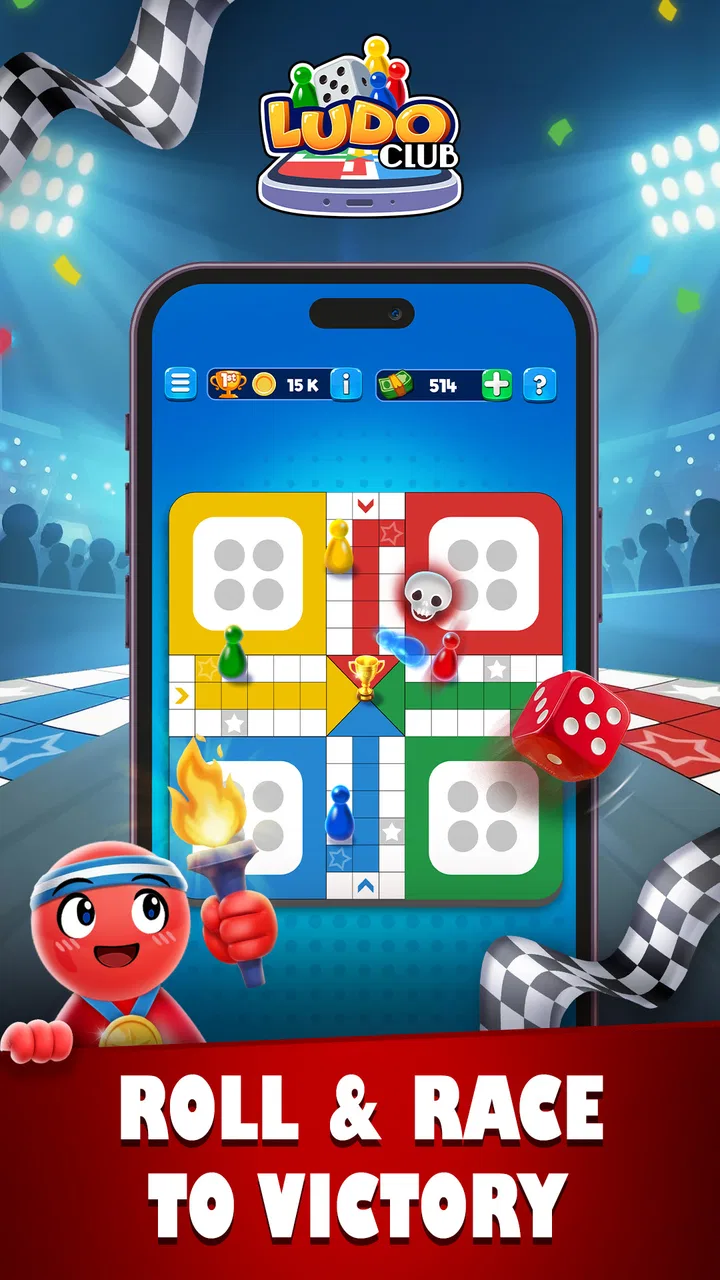
Ludo Club - Fun Dice Game
- 4.3
- Rating
- 100.00M
- Installs
- Free
- Price

 Analysis by App-foxy
I spent time with Ludo Club - Fun Dice Game as a casual board game, and my overall impression is straightforward: it is built for quick matches, familiar rules, and easy social play rather than deep strategy or a large collection of modes. That focus is part of its appeal. You can understand the basic objective quickly, invite friends into the experience, and start playing without first learning a complicated interface.
The game comes from Moonfrog and sits in the board-game category. It is free to install, aimed at Everyone, and has become a very widely used title, with over 100 million installs. Its average score is 4.3 from around 1.9 million ratings, which suggests that the simple formula works for a large audience, even though a popular casual game will naturally not satisfy every type of player.
How Ludo Club feels in everyday play
I find the everyday appeal comes from how little preparation a match asks of you: the familiar board gets everyone oriented, while the dice keep the outcome open. It helps to think of each game as a small shared activity rather than something to squeeze into a fixed number of minutes. That makes the next question less about setup and more about what keeps each turn engaging.
In-Depth Coverage of Ludo Club - Fun Dice Game
Quick turns make it easy to fit into a busy day
The strongest part of the experience is how naturally it fits into small gaps in the day. Ludo is already recognizable to many players, so the game does not need to spend much time teaching an unfamiliar concept. I can imagine opening it while waiting for an appointment, taking a few turns during a break, or using it as a low-pressure activity with friends after dinner.
That does not mean every match feels equally short. Dice results and the movement of several pieces can stretch a game, especially when players are close to finishing and every roll matters. Still, the individual turns are easy to follow, and the board gives you a clear visual reason to keep checking back. The pace feels more like a relaxed tabletop session than a demanding action game.
One useful habit is to decide before starting whether you want a quick distraction or a longer social match. If you only have a few minutes, beginning a full game can be inconvenient because the outcome depends on the other players and on the dice. For a planned group session, however, that same unpredictability gives everyone something to discuss and keeps the match from becoming a purely automatic race.
Simple rules do not mean completely mindless decisions
The dice introduce luck, but your choices still matter. When more than one piece can move, I have to think about whether to advance a safer piece, bring another one onto the board, or create a better chance of reaching the finish. Those decisions are not complex enough to turn the game into a strategy specialist’s hobby, yet they give each roll a little more meaning than simply tapping the most obvious option.
A practical tip is to avoid treating the piece closest to the finish as the only important one. Depending on the position of the other pieces, spreading progress can give you more useful choices on later turns. I also found that watching the whole board is more valuable than staring only at my own pieces. A move that looks efficient for me may leave another piece exposed or give an opponent a convenient opportunity.
This is where the game works best for families and mixed-skill groups. A newcomer can participate almost immediately, while experienced players can still talk through risk and timing. It is not the right choice if you want a board game with long-term character development, elaborate planning, or a campaign structure. Its pleasure comes from short decisions inside a familiar race, not from building a complex system over many hours.
Playing with friends changes the value of the game
The social promise is central to the title. The store summary invites players to join the club and play with friends, and that is a better description of its purpose than viewing it as a solitary puzzle. With people you know, a lucky roll becomes a joke, a missed opportunity becomes something to debate, and an unexpected comeback can keep everyone engaged.
For a realistic everyday scenario, imagine a family where one person prefers mobile games, another rarely plays anything, and children want something they can understand quickly. This is the kind of situation in which the game makes sense. The rules are approachable, the board is familiar, and nobody has to memorize a large set of abilities before joining. It can also work for friends who want a shared activity without committing to a competitive game that demands constant concentration.
There is a trade-off, though. If the people you want to play with are not available, the social advantage becomes less important. A player looking for a rich solo experience may find the basic board race repetitive after several sessions. I would choose a deeper digital board game for long evenings alone, while choosing this one when the main goal is to get a group playing quickly.
What to expect during heavier use
Repeated matches place a different kind of demand on a casual title than a single test does. The issue is not only whether one game starts smoothly; it is whether the experience remains comfortable when you play several rounds, switch between social sessions, and keep returning to the same familiar board. Because the game is designed around repeatable matches, its long-term appeal depends heavily on whether the basic loop continues to feel enjoyable.
My advice is to treat it as a game for bursts rather than an obligation to play continuously. A short session can feel refreshing, while a long run of matches may make the dice-driven structure feel predictable or frustrating. Taking a break after an unlucky round is especially sensible. Returning later makes the social and casual qualities more noticeable than trying to force entertainment from repeated losses.
Heavy use also exposes a personal preference: some players enjoy the emotional swings created by luck, while others dislike losing after making sensible decisions. This game cannot remove that tension because it is part of the ludo format. If you want outcomes to reflect skill more consistently, a turn-based strategy game with fewer random elements will probably be a better fit.
You May Also Like

 AccuWeather: Weather Radar
AccuWeather Review: A Quick, Clear Forecast for Everyday Decisions
For everyday plans, the best forecast is the one you can understand quickly. AccuWeather makes rain timing, radar, and local conditions easy to act on, with a few trade-offs.

 Hill Climb Racing
Why Hill Climb Racing Still Turns Crashes Into One More Run
A tiny car, a bumpy hill and one more upgrade: Hill Climb Racing keeps resurfacing because its simple chaos makes every near-miss feel personal.

 AliExpress - Shopping App
AliExpress Makes Global Shopping Feel Personal, but Shoppers Bear the Risk
AliExpress turns a global marketplace into a pocket-sized discovery engine. Its reach is useful, its shopping loop compelling, and its trade-offs easy to miss.

 Lords Mobile: Kingdom Wars
Lords Mobile Is a Kingdom-Building Routine, Not a Quick Match
A case-by-case verdict on the building, battles, device demands, and social commitments that make Lords Mobile rewarding for some players and exhausting for others.

 PDF Scanner app - TapScanner
TapScanner Makes Paperwork Easier to Capture, Check, and Share
TapScanner makes scanning with a phone feel less like a rescue operation and more like a dependable step in getting work done. Its capture tools are useful, though not flawless.

 Block Blast!
 Shows How Much a Puzzle Game Can Leave Out
A quiet grid game shows why puzzle players increasingly value instant clarity, repeatable skill and low-pressure play—and where the genre still needs to catch up.
More From Our News Desk
View All News


Reliability matters more than visual ambition here
For a game with a straightforward board, reliability is more important to me than visual spectacle. I want the board state to be understandable, turns to be clear, and progress to feel easy to follow. A simple presentation can be a strength because it keeps attention on the pieces and the decisions instead of overwhelming the screen with unnecessary decoration.
At the same time, social play makes any interruption more noticeable. In a match with friends, a pause or a disrupted session affects more than one person. I recommend beginning a group game when your connection and battery situation are reasonably comfortable, rather than starting just before you need to leave. That is not unique to this title, but it is particularly relevant when the attraction is playing together rather than practicing alone.
The current version is 2.6.10, so users should keep the installed build current through their platform when updates are offered. Staying current is a sensible part of maintaining a smooth experience, especially for a game that depends on shared play. I would not promise that every device or every session will behave identically, but the broad adoption of the title makes it clear that it is intended for regular, large-scale use.
Device expectations and the practical cost
The listed minimum operating-system requirement is Android 7.1, which gives the game a relatively broad starting point for Android users. That makes it more approachable than games designed only for recent phones. Still, an older supported operating system does not guarantee identical comfort on every device. Available storage, background activity, battery condition, and the general health of the phone can all affect how pleasant any frequently used game feels.
I would be comfortable recommending it to someone with an older Android phone who wants a lightweight-feeling board experience, but I would set realistic expectations. A phone that already struggles with everyday apps may not provide the same responsiveness as a newer device. If your handset has very limited free space or aggressive battery-saving behavior, it is worth closing unnecessary background apps before a longer session and checking that the game has enough room to update.
The game is free, which removes the biggest barrier to trying it. However, it includes optional in-app purchases ranging from $0.10 to $999.99 per item. That is a wide displayed range, and it is exactly why I would advise using purchase protections if children share the device. Free installation does not mean every optional item is free, so I would review the purchase settings before handing the phone to a younger player.
The Everyone content rating is reassuring for families who want a broadly accessible board game, but parents should still distinguish content suitability from spending control. A game can be appropriate for a child and still deserve sensible limits around purchases and screen time. In my view, that is the more useful way to evaluate this title in a family setting.
How it compares with physical ludo and other mobile board games
Compared with a physical ludo board, the mobile version is more convenient. You do not need to find the board, pieces, and dice, and a phone is easier to carry. The digital format also makes it simpler to arrange a session when people are not sitting around the same table, depending on how you choose to play. The physical alternative still has a warmer social presence, and some families will prefer the shared table, visible dice, and freedom from device distractions.
Compared with chess or other serious strategy games, this is much easier to enter but less demanding to master. Chess rewards planning across many turns and offers a more skill-centered experience. Ludo Club is better when you want rules that most people can grasp quickly and a result shaped partly by chance. Neither approach is universally better; they serve different moods.
Compared with other casual board apps, the main reason to choose this one is its recognizable ludo format and its emphasis on playing with friends. The reason to skip it is equally clear: if you want many distinct games, elaborate customization, or a solo mode with substantial progression, a broader board-game collection may offer more variety. I would not install this expecting a digital tabletop library. I would install it because I specifically want ludo in a convenient social format.
Small habits that improve the experience
First, agree on the session before inviting people. A casual match can become awkward if one player expects a quick round and another expects to continue for a long time. Setting that expectation helps the game remain a social activity instead of turning into a source of frustration.
Second, watch the board before tapping. The most obvious move is not always the most useful one, particularly when several pieces are available. Taking an extra moment to compare safety, distance, and the position of opponents can make the game feel more thoughtful without making it slow.
Third, separate enjoyment from winning. Because luck has a visible role, a strong decision can still produce a poor result. If you judge every session only by victory, the game may feel unfair. If you treat it as a shared race with occasional tactical choices, the reversals become part of the entertainment.
Finally, manage purchases before a child or less experienced user plays. The free entry point is convenient, but the presence of optional items means the device owner should remain in control of spending. That simple preparation prevents the most avoidable kind of disappointment.
Who should download it, and who should pass
I recommend it to players who want a familiar board game that can bring friends or family into the same activity quickly. It is especially suitable for mixed groups where not everyone considers themselves a gamer. The accessible rules, recognizable race format, and casual rhythm make it less intimidating than many competitive mobile games.
I would also suggest it to someone who values convenience over the atmosphere of a physical board. Having the game on a phone is useful when travel, distance, or lack of equipment makes a traditional session impractical. The large install base and strong average rating show that the format has broad appeal, although popularity alone should not decide whether its luck-based structure suits you.
I would skip it if you dislike random outcomes, need a substantial single-player campaign, or want a game that constantly introduces new systems. I would also choose another option if your priority is a highly competitive environment where careful skill should dominate the result. This is a relaxed ludo experience, not a replacement for every kind of board game.
My performance and value verdict
After looking at the way it fits into short sessions, repeated play, shared matches, and a range of Android devices, I see Ludo Club as a practical casual download rather than a technically ambitious game. Its greatest performance advantage is its focused design: there is a clear board, a clear goal, and little conceptual overhead before you can start playing.
That focus also defines its limits. The same familiar loop that makes it welcoming can become repetitive, and the dice can make a carefully played match end in a way that feels unsatisfying. Social company improves the experience considerably, while solitary use is more dependent on how much you enjoy the underlying ludo format.
Moonfrog’s game is free to try, supports a broad Android starting point with its 7.1 minimum requirement, and is rated for Everyone. Just remember that optional purchases are present, with individual items listed from $0.10 up to $999.99. For me, the best reason to keep it installed is not endless solo progression but a fast, familiar way to turn spare time into a shared board-game session.
In the end, I would recommend it to a friend who says, “I want something simple that we can play together.” I would not recommend it to someone asking for deep strategy or a rich campaign. Used for the right purpose, it is approachable, convenient, and easy to return to; judged as a complete board-game collection, it is naturally much narrower.
FAQs for Ludo Club - Fun Dice Game
01What is Ludo Club and how does it differ from traditional Ludo?
Ludo Club is a digital adaptation of the classic board game Ludo, available on Android and iOS devices. Unlike traditional Ludo, Ludo Club offers online multiplayer capabilities, allowing you to play with friends or players worldwide. It also includes various themes and power-ups, adding a modern twist to the classic gameplay.
02Are there any in-app purchases in Ludo Club?
Yes, Ludo Club includes in-app purchases that allow players to buy coins and gems. These can be used to unlock special features, themes, and power-ups. While the game is free to download and play, these purchases can enhance your gaming experience by providing additional customization and advantages.
03Can I play Ludo Club offline, or is an internet connection required?
Ludo Club offers both offline and online modes. You can play offline against computer opponents when you don't have an internet connection. However, for multiplayer games, such as playing with friends or joining global matches, an active internet connection is required.
04How does the multiplayer mode work in Ludo Club?
In Ludo Club, the multiplayer mode allows you to connect with friends by linking your Facebook account or by inviting them directly through the game. You can also join matches with random players around the world. The game ensures a smooth experience with real-time interactions, making it engaging and competitive.
05What are the system requirements to install Ludo Club on my device?
Ludo Club is designed to run smoothly on most modern smartphones and tablets. For Android, it typically requires version 4.4 and up, and for iOS, it generally requires iOS 9.0 or later. Ensure you have sufficient storage space and a stable internet connection for optimal performance.
Pros
- Engaging multiplayer mode
- Smooth and intuitive interface
- Quick matches for busy players
- Colorful and appealing graphics
- Daily rewards keep users motivated
Cons
- Occasional connectivity issues
- In-app ads can be intrusive
- Limited customization options
- Requires internet connection
- No single-player offline mode

Ludo Club - Fun Dice Game
Gallery